 View full size ↗
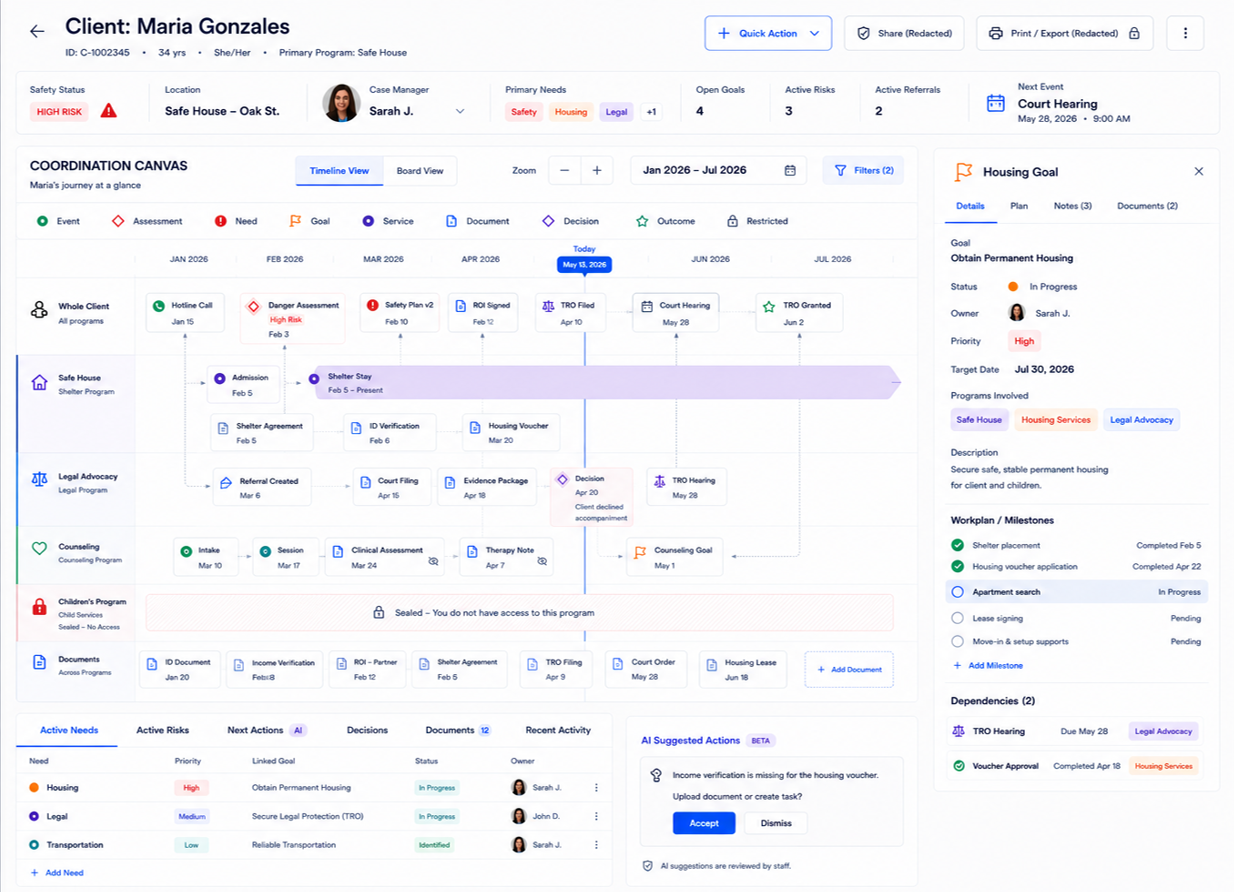
Crisis intake at 2am. Danger assessment as the call is happening. Safety plans built with the survivor, not handed to them. Confidentiality protections survivors can verify. Funder reports for VOCA, FVPSA, and OVW that pull from the work you've already done. Built around the practice of DV advocacy — not retrofitted from generic case management.
Much of the case management software on the market was built for programs where the worst-case mistake is a missed appointment. DV advocates work in a context where the worst-case mistake is a survivor's safety. The differences matter — in the intake, in the data model, in who can see what, in how confidentiality is enforced, in what gets reported up to funders, and in how the interface itself is designed to feel.
Generic case management software handles the rhythm of a service plan well enough. It does not understand that a survivor's address is the most sensitive piece of information in the building. It does not know that the perpetrator might be a donor, a board member, a former volunteer — and that their record needs to be sealed off from the survivor's case in ways that don't exist in any other program. It does not know that an advocate calling a survivor at home can put the survivor in danger, and that the system has to know which contact methods are safe for which survivors at which times.
ClearWind.AI's DV Case Management module was built with these realities at the center, not the margin. The result is software that DV advocates can actually use — and that survivors and funders can both trust.
View full size ↗The phone rings. Sam, your overnight advocate, picks up. The caller is in crisis — it's a partner she just got away from for the third time, she's at a gas station, she has the kids in the car, and she's not sure what to do next.
Sam opens the crisis intake. The form starts with the questions that matter most when someone might be in immediate danger — the kind of incident, whether weapons were involved, whether children are present, whether the perpetrator knows where she is right now. The fields that come first are the fields a survivor in a parking lot at 2am can answer in two minutes. The system surfaces them. The fields that can wait — the demographic questions, the program eligibility — appear later, after the person on the other end of the phone is safer.
As Sam types, a danger score appears at the top of the screen. Not as a verdict — Sam is the human, she makes the call — but as a signal. Today's intake reads as high lethality on the validated assessments your agency uses. The system noted it. So did the supervisor's queue.
Sam offers shelter. The system already knows which shelters in your network have beds tonight, which ones can accommodate children of the ages this caller has, which ones don't require ID at intake (because she doesn't have it with her). Sam makes the warm referral with one click. The shelter sees the case context — only what they need to know — and confirms within minutes.
Before Sam hangs up, she asks the survivor how it's safe to follow up. The survivor's preferences — phone okay during work hours from this number only, no mail, no email yet because the perpetrator monitors the account — get saved to the record. From this moment forward, no one in the agency will accidentally call the wrong number, mail to a forwarding address, or email an account the abuser can read.
The next morning, Sam's day-shift colleague picks up the case. The notes from the call are there. The danger score is there. The shelter intake is logged. The follow-up plan is there. The colleague doesn't have to ask the survivor to tell the story again.
This is the work. The platform was designed around it.
An intake form that knows time matters. The questions that have to come first — immediate danger, presence of weapons, children involved, where the survivor is right now — surface first, with the right escalation paths if any of them flag risk. The questions that can wait — demographics, eligibility, program-specific requirements — appear after the safety questions are answered. Total intake time during a crisis call is under two minutes. The full record can be filled in over the following days.
The validated risk assessments your agency already uses — the Campbell Danger Assessment, the Maryland Lethality Screen, your own — are part of the intake flow, not a separate form your advocate fills out later. Scoring runs as the questions are answered. High-lethality cases trigger an immediate supervisor alert. The score is shown to the advocate as a signal, not a verdict — your team makes the call.
A nine-section safety plan builder that draws on the survivor's actual circumstances — where they live, who knows where they are, what resources they have, what the perpetrator's pattern looks like. The advocate and survivor co-create the plan. AI can draft a starting point grounded in the case context for the advocate to review and customize — but the plan is never sent to the survivor without an advocate's eyes on it. Plans are versioned, so you can see what changed and when.
Real-time bed availability across your shelter network. Filter by who they accept (children of certain ages, people without ID, people with pets, people with substance use histories, people with disabilities) and what they can offer (length of stay, services on site, transportation). Submit a referral with the case context the receiving shelter needs — and only what they need. Track placement, length of stay, and exit. The survivor's continuity of care follows them, even as they move across the network.
Track the lifecycle of every protective order — from the petition through service, conditions, violations, renewals, and expiration. Reminders fire before the order expires. Violation logs document what happened, when, with the supporting evidence. Court appearances are calendared. Outcomes — granted, denied, modified — are part of the record so future cases benefit from the agency's collective experience.
The most important data security in the building. Survivor addresses are encrypted by default. Specific staff roles can see them; everyone else cannot. If the perpetrator is also in your database — as a former donor, a board member, a volunteer — their record can be sealed from the survivor's case so a search doesn't accidentally cross the streams. Address Confidentiality Program enrollment is tracked. Communication channel preferences are honored across every campaign and reminder the agency sends.
Log services — counseling, court advocacy, hotline, shelter, accompaniment, transportation — as they happen. Individual or batch. Each service connects to the right grant and the right reporting category. Service hours roll up to the funder report automatically. Hours your advocates work on civil legal advocacy don't get counted against criminal justice advocacy by accident.
Pre-built templates for the major federal sources, plus state coalition templates for the larger state systems. The data was already there because your advocates were working in the system. The narrative drafts itself from the actual program activity. The forty-hour quarterly scramble becomes a two-hour review. Submission tracking from draft to accepted means nothing falls through the cracks.
Critical alerts use amber and blue, not red — because red is the color of injury and we don't want survivors browsing the portal to flinch when they see it. A quick-exit button is on every screen the survivor might use, taking them to a neutral page in one click. The language throughout is gentle, not clinical. Session timeout warnings appear before they expire so a survivor who steps away doesn't lose their work.
Domestic violence advocacy is the kind of work where a wrong recommendation has consequences that no software vendor should ever pretend to be comfortable with. ClearWind.AI's AI in this module operates under tighter guardrails than anywhere else in the platform.
The AI drafts safety plans — but it never sends them. An advocate reviews every plan before it's shared with a survivor.
The AI surfaces risk signals — but it doesn't make the call. High-lethality scores trigger supervisor review, not automated case-routing decisions.
The AI suggests re-engagement outreach for survivors who've stopped responding — but it does not contact anyone autonomously. An advocate decides whether outreach is safe.
The AI processes voice-to-note for case documentation — but the audio and transcript stay inside the platform. They do not travel to outside services. They are not used to train models trained on someone else's data.
Sensitive information — survivor address, perpetrator identifiers, medical details, immigration status — is masked before it ever appears in a context where AI could surface it inappropriately. Your compliance team can audit which AI requests touched which information.
The point of the AI in this module is to give time back to advocates so they can do the work they trained for. Not to replace them. Not to automate them. Not to send anyone a recommendation the agency hasn't vetted.
"Trauma-informed" is widely used in nonprofit software marketing. Many products that use it have done minor cosmetic work — softer language, gentler colors — and called it a day. ClearWind.AI's DV module took the term as a design constraint that shapes the entire product.
Survivors using the participant portal can quick-exit at any time. Their session terminates and they land on a neutral page. A quick exit does not guarantee removal of browser history or other device records. Agencies should explain these limits as part of participant digital-safety guidance.
Communication preferences are granular and honored. A survivor who said "phone calls only from this number, only between 1pm and 4pm, never leave a voicemail" doesn't have to repeat that to the next advocate, the volunteer coordinator, or the development office. The system enforces the preferences across every channel.
Address Confidentiality Program participation is a first-class concept. Survivors enrolled in their state's ACP have their substitute address used everywhere mail is generated — donor acknowledgments, event invitations, volunteer thank-yous — without the front desk having to remember.
Perpetrator-aware access controls keep the survivor's case sealed off from any record of the perpetrator that might exist elsewhere in your database. If the perpetrator was a donor, the development team can see the giving history. If the perpetrator becomes the subject of a survivor's case, the development team's access to that record can be locked while the survivor is in services. The boundaries are configurable, enforceable, and auditable.
This is what the term should mean. ClearWind.AI built it.
| Capability | ClearWind.AI DV | Generic case management |
|---|---|---|
| Crisis intake under 2 min | Yes — built around hotline calls | No |
| Validated danger assessments embedded | Campbell, Maryland, custom | Manual checklist |
| Safety plan builder with versioning | 9-section co-creation | Free-text notes |
| Real-time shelter bed coordination | Across your network | Phone calls |
| Protective order lifecycle | Petition through expiration | Tracked manually |
| Perpetrator-aware access control | Field-level enforcement | Whole-record only |
| VOCA / FVPSA / OVW templates | Built in with auto-fill | Generic exports only |
| Quick-exit button | Every survivor-facing screen | No |
| Trauma-informed visual design | Designed with survivors | Standard UI |
Switching from legacy software? Our AI-assisted migration is often free. We confirm scope and any cost before you commit. Learn about Migration →