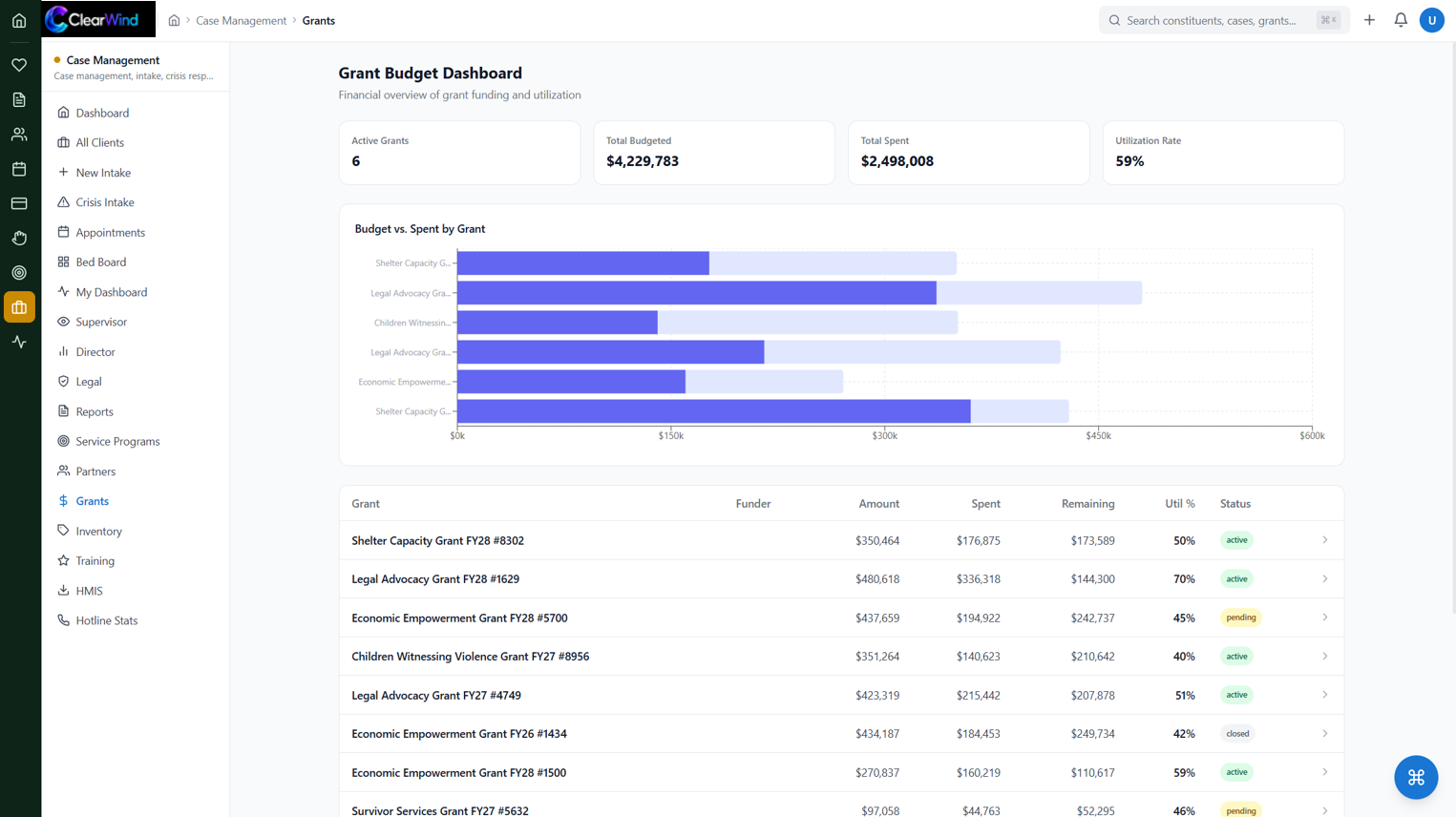
 View full size ↗
Grants management built for the way development teams actually work. Discovery to closeout. Pipeline kanban, funder relationship intelligence, multi-year budgets, expense tracking, federal report templates with AI-drafted narratives. Built so a missed deadline is impossible — not just unlikely.
Many grant managers spend significant time each month searching foundation directories and government portals for opportunities — manually checking eligibility, manually copying contact information, manually tracking which deadlines they need to remember. Every new application starts blank. The boilerplate, the organizational descriptions, the impact data, the financials — all of it gets re-gathered and re-formatted from scratch.
Compliance is where organizations often lose grants they already won. The interim report deadline slips past unnoticed. The match documentation isn't complete when the funder asks. The expense codes don't tie back to the budget cleanly. The funder finds the problem before the finance team does.
ClearWind.AI's grants module addresses all three. Discovery uses your organization's actual programs and capacity to surface opportunities — not keyword search. Applications draw on a content library that grows with every submission. Compliance runs on a calendar that nobody has to maintain manually.
View full size ↗Monday morning, James opens the dashboard. The grant pipeline is in front of him as a kanban board — eight stages from prospect through closed. Each card is color-coded by deadline urgency. The five awards in the "Active" column show their compliance status at a glance: green for everything on track, amber for an interim report due this month, red for a budget line that's running ahead of schedule.
He drags a card from "Researching" to "Writing." A new federal opportunity matched to the organization's housing program last week — the system surfaced it because the eligibility profile fit, not because someone went hunting. The application is drafted in the content library: the boilerplate sections are pre-filled from the existing grants the org has won. The unique narrative is what James will write today.
The narrative drafts itself from the actual program activity that's been logged in the case management module all year. James edits the draft for the funder's particular voice and priorities, adds the program-specific examples that make it land, and sends it to the executive director for review by Wednesday. It's a draft built from real data, not invented from nothing.
Wednesday afternoon, James is in a meeting with the finance director. They're looking at the burn rate on three federal awards together — same numbers, same view, no spreadsheet exchange. One of the awards is running 12% behind on personnel; they decide to shift hours from an underutilized line to keep the work covered. The budget modification is logged with the funder-required justification and submitted with one click.
Friday morning, James submits two interim reports. The data was already there because the program team had been logging service activity throughout the quarter. The narrative is grounded in that activity. The match documentation — volunteer hours, in-kind contributions — flows automatically from the volunteer module. Forty hours of work compressed into three.
This is what grants management looks like when the platform was designed around the work.
An eight-stage kanban from prospect through closed. Drag-drop. Color-coded by deadline urgency. See your full portfolio at a glance — what's submitted, what's under review, what's been awarded, what's in active reporting. Filter by funder type, by program, by team member, by amount.
A searchable database of funders with their giving history, program officer contacts, communication notes, and a relationship strength score for each one. The relationship history is part of the constituent record — funders are constituents, just like donors and partner organizations. The development team sees the same picture.
Multi-year budgets with line-item categories: personnel, fringe, travel, equipment, supplies, contractual, other, indirect. Indirect cost auto-calculation. Budget modification tracking with the funder-required justification documentation built in. Approval workflow before modifications are submitted.
Tie expenses to budget lines with remaining-balance display. Multi-level approval flow. Match tracking with volunteer-hour valuation and in-kind contributions auto-pulling from the volunteer module. Burn rate monitoring across active awards.
Automated deadline alerts at 60, 30, 14, and 7 days for application deadlines, interim reports, and final reports. Per-funder scorecard with budget ceiling alerts. Required document tracking. The grants manager never has to wonder what's due next.
Pre-built templates for the major federal sources — VOCA, OVW, HUD, HRSA, SAMHSA, ACF, ED. Fourteen-day pre-due batch assembly. Eight categories of QA validation built in. Submission workflow from draft through internal approvals through funder receipt.
Store the boilerplate, organizational descriptions, financial summaries, and impact data once. The system suggests the most relevant content for each new application as you write. The library grows with every submission — so the next application is faster than the last one.
Visual logic model creation linking inputs to activities to outputs to outcomes. Funders see your theory of change. Outcomes data flows directly into report templates from the actual service-delivery logged in case management.
Grant discovery. Semantic matching against your organization's mission, programs, and capacity — not keyword search. Surfaces opportunities you'd miss in a directory full-text search. Reclaims the hours grant managers typically lose to hunting.
Narrative drafting. Federal report narratives drafted from your actual service-delivery data. Edit in place. Submit when ready. Your voice, your judgment, just faster.
Proposal critique. Section-by-section analysis of your draft against the funder's priorities and stated criteria. Surfaces gaps before you submit, not after the funder declines.
Burn rate forecasting. Where will spending land at end-of-period given the current trajectory? Surface budget lines that need attention before they become a finding.
Plain-English reporting. "Show me grants closing in the next sixty days where final reports haven't been started." Get the answer in seconds, with the priority list.
Many development teams pay for a grant-discovery tool, a separate application-management product, a CRM that doesn't talk to either, and a finance system that doesn't see the budget — each as its own contract with its own renewal cycle. ClearWind.AI replaces that stack with one platform where the funder relationship, the application, the budget, and the outcomes data all live on the same record.
Switching from legacy software? Our AI-assisted migration is often free. We confirm scope and any cost before you commit. Learn about Migration →